
Ask ChatGPT for “the best plumber in Brighton, Colorado” and it’ll happily hand you a short list. Not ten blue links. Not three pages of ads. Just a handful of names — and if yours isn’t one of them, that customer may never know you exist.
And no, you don’t have to be a household name or spend thousands on marketing to show up. A well-established local business with a good website and a solid reputation has plenty to work with.
Last year we wrote about how you can use AI for SEO, meaning AI tools that help you do the work. This post flips it around. How do the AI tools themselves decide which businesses to mention? And what can you do to be one of the lucky few?
The marketing world has already invented names for this, of course: generative engine optimization (GEO) and answer engine optimization (AEO). Fancy acronyms aside, the idea is simple. Make it easy for AI tools to find, understand, and recommend your business.
Why should you care?
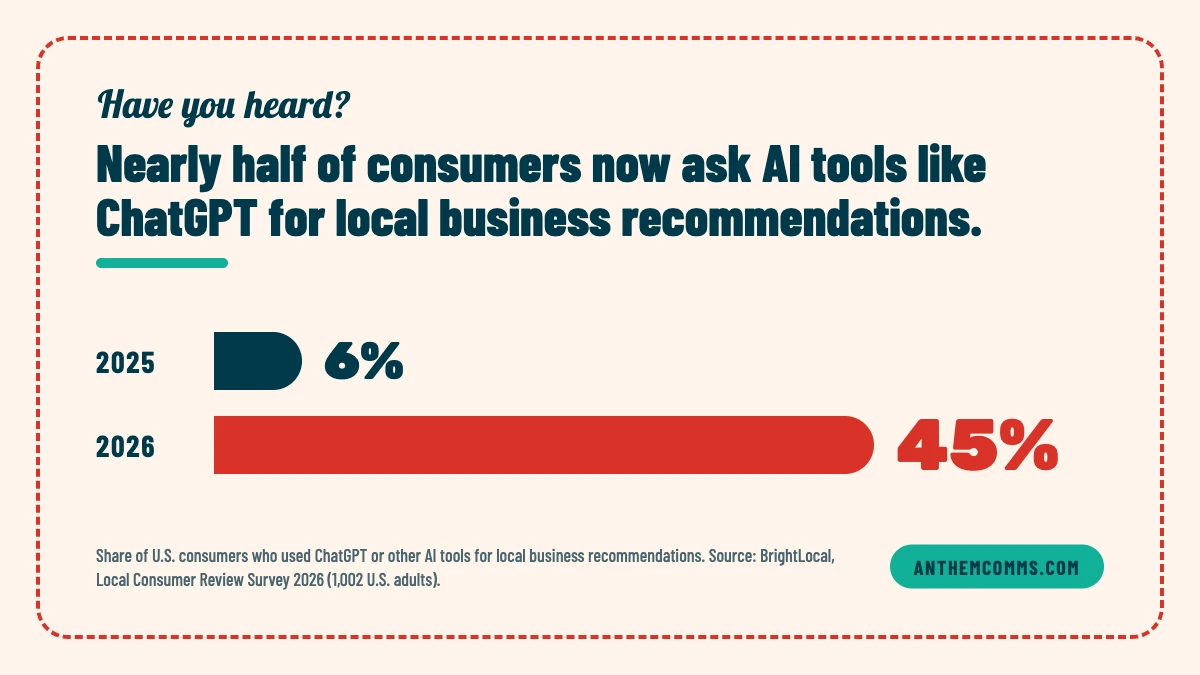
Because more people are asking AI, and fewer are clicking. In BrightLocal’s 2026 Local Consumer Review Survey, 45% of consumers said they’d used ChatGPT or another AI tool for local business recommendations. A year earlier, it was just 6%.
Meanwhile, when Pew Research tracked the browsing of 900 U.S. adults in March 2025, people clicked a regular search result on just 8% of visits when a Google search included an AI summary, compared with 15% when it didn’t. Clicks on the links inside the AI summary? A whopping 1%.
Ahrefs has been tracking the same trend. In April 2025, it estimated that when an AI Overview appeared, the top-ranking result had a 34.5% lower organic click-through rate (that’s the percentage of people who see a result and actually click it). When it re-ran the study with December 2025 data, that estimate had grown to 58%.
Here’s the kicker: ranking #1 on Google still matters, but it’s no longer the whole game. Being the name in the answer matters too.
How does ChatGPT pick which businesses to mention?
OpenAI hasn’t published a secret recipe (we checked — no luck). What we do have are researchers poking at it and reporting what they see. Treat these as observations, not official rules.
First, ChatGPT’s search appears to lean heavily on Bing. Yes, Bing. In a 2025 Search Engine Land breakdown, Damian Rollison found that for local questions, ChatGPT seemed to skim roughly the top 20–30 Bing results, dig into the 5–8 that looked most promising, and then cite 3–5 sources. The sources it picked tended to show star ratings, weren’t stuck behind a paywall, and could be checked and linked.
Second, your own website matters more than you might think. BrightLocal ran 800 local searches in ChatGPT and recorded the first ten sources ChatGPT listed for each one. Business websites made up 58% of those sources. Mentions of businesses on other sites (articles, lists, and Wikipedia) made up 27%, and directories just 15%. For “I want to buy something” searches, business websites jumped to 72% of sources.
Keep in mind, those numbers describe the sources ChatGPT cited, not the businesses it recommended. And being cited isn’t the same as being recommended. ChatGPT might use your website as a source for a general answer and still recommend your competitor by name. Ideally, you want both.
One caveat: BrightLocal’s ChatGPT research dates back to late 2024, and Rollison’s analysis was published in May 2025. AI tools change faster than a Colorado forecast. Answers also vary depending on where the person is, how they word the question, what the tool already knows about them, and whether it searches the web live or answers from memory. Treat the specifics as a snapshot, not scripture.
How do Google’s AI Overviews choose their sources?
Google is a bit more forthcoming. Its own guide to AI features says there are no extra requirements or special tricks for showing up in AI Overviews or AI Mode. Your page needs to be indexed and eligible to show in Google with a snippet.
Note the word eligible. Meeting those requirements gets you in the running. It doesn’t guarantee you a spot.
In other words, AI Overviews pull from the same pool as regular Google search. Google also says these features may run several related searches behind the scenes to build one answer. So a page that clearly answers a related question can still get cited.
Google specifically mentions keeping your Business Profile up to date and making sure any structured data (behind-the-scenes code that labels your hours, address, and so on) matches what’s actually on the page.
10 ways to improve your visibility in AI search
1. Say it plainly on your website
Make it easy for AI to understand what your business does. Your site should spell out what you do, where you do it, and for whom. “We repair furnaces in Brighton, Commerce City, and Fort Lupton” beats “Comfort solutions for the modern home” every time. And make sure the important stuff is real text, not baked into an image (more on that in our post about images and SEO).
2. Don’t accidentally lock the robots out
OpenAI uses a crawler called OAI-SearchBot to find pages for ChatGPT search. Its crawler documentation says sites that block it won’t be shown in ChatGPT’s search answers.
Your robots.txt file isn’t the only possible culprit. Hosting firewalls, security plugins, and bot-blocking settings can turn AI crawlers away too, so ask whoever manages your site to check all of them. OpenAI even publishes the IP addresses its search crawler uses, so your web person can make sure they’re allowed through. (Blocking GPTBot, the one used for AI training, is a separate choice and doesn’t keep you out of search.)
One nuance: blocking OAI-SearchBot keeps your content out of ChatGPT’s search answers, but OpenAI says a blocked site can still show up as a plain navigational link. ChatGPT can also still mention you based on reviews, news stories, or directory listings. It just means you’re not the one telling your story.
3. Claim your Bing Places listing
We know, we know. Nobody has thought about Bing since 2011. But since ChatGPT appears to lean on Bing’s results, Search Engine Land recommends claiming and filling out your Bing Places for Business listing. It costs nothing, and plenty of your competitors haven’t bothered.
4. Claim and maintain your Google Business Profile
Google specifically recommends keeping your Business Profile current as part of showing up in its AI search features. Fill in your services, add real photos, keep your hours accurate (holidays included), and respond to your reviews. “Set it and forget it” doesn’t cut it here.
5. Get talked about elsewhere
Remember that 27% of ChatGPT’s sources were mentions on other sites? That’s local news stories, “best of” lists, community blogs, and chamber of commerce directories (hi, Brighton Chamber!). Sponsoring a local event or getting featured in a roundup isn’t just good PR anymore. It’s AI fuel.
6. Collect reviews, then collect some more
Rollison’s research suggests ChatGPT leans toward sources that show star ratings, and BrightLocal found it pulls in review info from Google too. A steady trickle of fresh, honest reviews beats a big burst from 2019.
Don’t put all your eggs in Google’s basket, either. Different AI tools lean on different sources, and BrightLocal found the average consumer uses six different review sites. Maintain an active presence on Facebook, Yelp, and whatever platforms matter in your industry (think Houzz for remodelers or Tripadvisor for restaurants). Encourage honest reviews wherever the platform’s rules allow it. (Heads up: Yelp’s terms for business accounts prohibit asking customers for reviews at all.)
Just keep it honest. Don’t buy reviews, offer incentives for reviews, or have your employees write them. It breaks the rules, and customers can smell it from a mile away.
7. Answer the questions people actually ask
People talk to AI like they talk to a friend: “Who’s a good, affordable web designer near Lochbuie who can also do a logo?” Pages that answer specific questions (pricing ranges, service areas, and how long things take) give the AI something to quote. An FAQ page or a regular blog is perfect for this. And if you offer several distinct services, give each one its own useful, descriptive page rather than cramming everything onto your homepage.
8. Publish things only you can publish
AI tools can churn out generic content all day long. What they can’t replicate is your firsthand experience. Case studies, photos of finished projects, customer testimonials, certifications, and your years in business give AI tools (and people) a reason to trust you over the next guy. That kitchen remodel you finished in Hudson? Write it up.
9. Keep your info identical everywhere
If your website says you close at 5, Google says 6, and Facebook still lists the address you moved out of in 2022, the AI has to guess. It might just pick someone else. Same name, address, phone number, and hours, everywhere.
10. Keep your website technically sound
The boring stuff still matters. Use descriptive page titles and clear headings, make sure any structured data is accurate, keep your navigation working, and submit a sitemap to both Google Search Console and Bing Webmaster Tools. Then check that your important pages are actually indexed (Search Console’s Page indexing report will tell you). A sitemap is an invitation, not a guarantee. If search engines can’t make sense of your site, the AI tools built on top of them can’t either. (New to all this? Start with our 5 SEO tips for beginners.)
Don’t fall for the AI SEO snake oil
Where there’s a new trend, there’s someone selling a miracle cure. If an email lands in your inbox promising any of these, hit delete:
- Guaranteed placement in ChatGPT. Nobody can guarantee what an AI tool will say. Not us, not them, not anyone.
- Hundreds of AI-written pages that offer nothing new. Google’s spam policies specifically call out using AI tools to churn out pages that don’t add value. That’s a fast way to get into trouble, not into the answer.
- A “secret” file or code that makes AI love you. Google says you don’t need special AI files or special markup to appear in its AI features. The fundamentals are the secret.
How do you know if it’s working?
Start low-tech: ask! Make a list of 10–20 questions your real customers would ask, like “Who does gutter cleaning in Fort Lupton?” Once a month, run them through ChatGPT, Gemini, Perplexity, and Google’s AI Mode.
A few tips to keep it fair: start a fresh conversation for each question (so the AI isn’t influenced by what you asked before), use the exact same wording every month, keep your location and account settings the same each time (or test while logged out), and write down the date. Then record whether your business is mentioned, whether your website is cited, which competitors show up, and anything the AI gets wrong about you (like old hours or a service you don’t offer). A simple spreadsheet works great. For a more reliable picture, run each question more than once, because AI answers aren’t always identical, even when the question is.
Then check your analytics. OpenAI’s publisher FAQ says ChatGPT tags its referral links with utm_source=chatgpt.com, which helps you spot those visits in analytics tools like Google Analytics. Traffic from Google’s AI Overviews is lumped in with regular search in Search Console. (Thanks, Google.)
Just remember that visibility and traffic aren’t the same thing. Some customers may discover your business through ChatGPT, then Google you or call you directly. Those customers won’t show up as “ChatGPT traffic” at all. So ask every new customer how they found you, and consider adding “AI tool like ChatGPT” as an option on your contact form.
The good news? Nearly everything on this list is plain old good marketing. If you’ve been doing the basics, you’re already ahead of the robots.
How can we help?
Not sure whether ChatGPT knows you exist? Ask us for an AI search visibility check. We’ll run the questions your customers are asking, show you how you stack up against your competitors, and tell you what to fix first. Anthem Communications helps small businesses across Brighton and the Front Range get found, whether your customers are searching Google or asking ChatGPT. Reach out to us today and let’s talk.